


.webp)
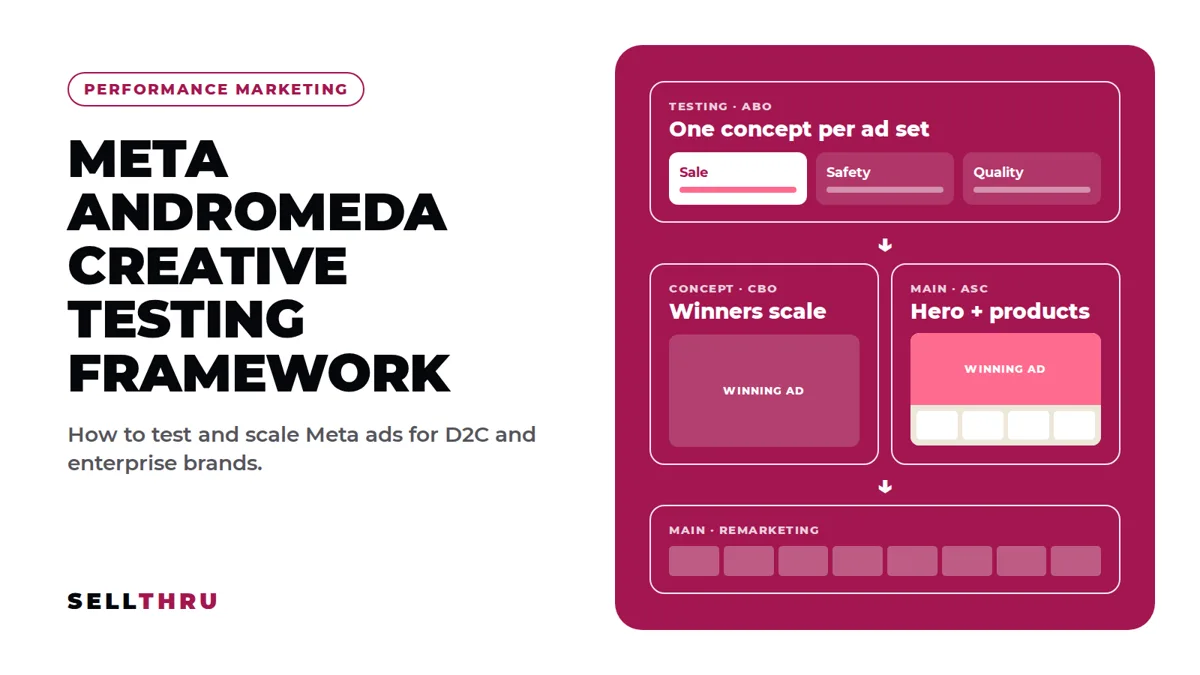
Every Meta account we inherit tells the same story. There's a main prospecting campaign and a main remarketing campaign, both on Advantage+, both working. The client's Meta account manager says don't touch them. Meanwhile the brand wants fresh creative tested, and every attempt to add it ends with the same complaint: "we tried new creatives and they didn't spend."
Both sides are right, and this is the framework our Meta ads team uses to reconcile them. It keeps the main campaigns intact, gives every new concept a fair test, and moves the winners into the places they'll actually scale.
What the Meta Andromeda update actually changed
Andromeda is Meta's ad retrieval engine across Facebook and Instagram: the step that narrows tens of millions of eligible ads down to the few thousand considered for each person. A separate model, GEM, then ranks that shortlist. In its guidance on creative diversification, Meta is explicit that giving the system meaningfully different creatives is now the main lever for reaching the right people. Audience targeting matters far less than it used to.
That has a practical consequence most accounts get wrong. Andromeda doesn't reward more ad sets. Splitting an account into dozens of narrow ad sets just thins out the signal each one learns from. It rewards more genuinely different ideas inside fewer, consolidated campaigns. That's exactly what Meta's account managers mean when they push one prospecting and one remarketing campaign.
The catch is the "protect" part. A catalog ad is effectively thousands of product ads with years of conversion history. Put three new videos next to it and it will win almost every auction, not because the videos are bad, but because it's an unfair fight. So new concepts need somewhere to prove themselves first.
D2C or enterprise: which framework do you need?
The logic is the same for every account. What changes is how many campaigns the account has enough purchases to feed. This applies whether the store runs on Shopify or a custom build.
| D2C version | Enterprise version | |
|---|---|---|
| Typical account | Under ~100 Meta purchases a week, hundreds of SKUs | Over ~100 Meta purchases a week, thousands of SKUs |
| Campaigns | 3: test, main prospecting, main remarketing | 4: test, concept, main prospecting, main remarketing |
| Where winners go | Main prospecting, as hero ads over a matching product set | A CBO concept campaign, plus hero ads in main prospecting |
| Categories per sprint | 1 | 2 to 3 |
| Sprint length | 3 to 4 weeks | 2 weeks |
The 100-purchase line is our rule of thumb, not a Meta rule. It comes from the learning phase: each ad set needs roughly 50 optimisation events a week to stabilise, and smaller accounts can't spread that across four campaigns.
ABO vs CBO: which to use for creative testing
This is the question we get most, and the answer is both, at different stages. Ad set budget optimisation (ABO) fixes the budget on each ad set. Campaign budget optimisation (CBO, now called Advantage+ campaign budget) lets Meta move budget between ad sets towards whatever is converting.
| ABO | CBO | |
|---|---|---|
| Who decides spend | You, per ad set | Meta, across ad sets |
| Best for | Testing new concepts | Scaling proven winners |
| Why | Every concept gets the same budget, so every concept gets a verdict | Budget flows to the best performer without manual shifting |
| Risk | Spend on clear losers until you switch them off | Picks a favourite early and starves the rest, so you never learn about them |
So we test on ABO and scale on CBO. The rest of this framework is how winners get from one to the other.
Enterprise framework: how to test and scale creatives for a 25,000-SKU retailer
MAIN | Prospecting | ASC and MAIN | Remarketing | ASC at scale. We're testing new creatives for two categories: car seats and strollers.Build a separate testing campaign on ABO
One new campaign with the budget at ad set level (ABO), equal on every ad set. We don't use campaign budget (CBO) here: it picks a favourite in the first few days and starves the rest, so starved concepts end up "unknown", not "lost". You can build it as a manual sales campaign or as an Advantage+ sales campaign with ad set budgets. What matters is that each ad set has its own budget.
| Setting | What we use |
|---|---|
| Name | TEST | ABO |
| Objective | Sales, optimised for purchase |
| Budget | Ad set level, equal daily budget on every ad set |
| Audience | Broad. Purchasers in the last 180 days excluded, so we read new customers only |
| Placements | Advantage+ placements |
| Duration | 14 days |
One category, one concept, one ad set
For car seats we pick three concepts: sale, safety and quality. Each gets its own ad set, holding only that concept's creatives, usually a static, a video and a carousel. Strollers follow the same pattern. If you're unsure what counts as a genuinely different concept rather than a new headline, score your ideas with our free Creative Ad Framework before briefing them.
Budget: with a target CPA of AED 200, each ad set needs at least AED 500 before you judge it. At AED 100 a day per ad set, six ad sets cost AED 600 a day and each spends AED 1,400 over 14 days. If the budget can't cover every ad set, test fewer of them rather than cutting each one's budget.
Read the results in two passes
Leave everything alone for the first 7 days. After 14 days, compare ad sets first (which concepts won on cost per new customer), then ads (which execution won inside the winning ad sets).
Turn the test off and log every result, losers included. "Quality doesn't work for car seats" stops the same idea being re-briefed next quarter.
How to scale Facebook ads that win: a CBO concept campaign
Winners now run by themselves at scale, still away from the catalog, in a campaign on CBO. Testing is done, so now we want Meta pushing budget towards the best performer.
Use one ad set per category, not one per concept. Winners can now share an ad set because each has earned its place. Per-category ad sets keep reporting clean and let you add a category without resetting the others. Start at roughly 20 to 25% of the main prospecting budget, keep it to about five ad sets, and merge small categories into one CONCEPT | Mixed ad set if they can't reach around 50 purchases a week.
Add winners to main prospecting as hero ads
Winners also go into the main campaign, in parallel, but never as standalone ads, because the catalog would starve them. Each becomes the hero of a catalog or collection ad, with a product set from the same category underneath.
Clean category product sets depend on a well-structured catalog feed. On Shopify stores that's the first thing our Shopify development team checks. Some overlap with the concept campaign is expected, but Meta's auction avoids entering multiple ads from the same advertiser against each other, so the cost is small. The two do different jobs: one finds new customers with the story, the other uses the story to sell specific products.
Review, prune and run the next sprint
- Main prospecting: after about two weeks, a hero ad stays only if it beats the catalog control on cost per new customer. Keep 6 to 8 at most.
- Concept campaign: when cost per purchase rises two weeks running and frequency climbs, replace the ad with the next winner.
- Main remarketing: unchanged. It pairs best with owned channels, which is where our CRM and retention team picks up abandoned carts on email and WhatsApp.
- Next sprint: reuse
TEST | ABOwith new ad sets. A new category gets a new concept ad set. A new concept in an existing category joins that category's ad set.
D2C framework: how to test and scale creatives for a smaller brand
Most of the D2C brands we work with sit on Shopify, and the account structure has to fit the volume. If that's you, our fashion and footwear Shopify practice runs this exact setup.
Same testing campaign, smaller and longer
Settings are identical to the enterprise version. Three things change: one category per sprint, 3 to 4 weeks instead of 2 (the 2.5x CPA rule doesn't change, so a smaller budget means a longer sprint), and concepts that lean on the product and brand rather than price alone.
Budget: with a target CPA of AED 250, each ad set needs AED 625 before you judge it. Three ad sets at AED 60 a day spend about AED 1,260 each over three weeks.
Winners go into main prospecting, over a product set
There's no separate concept campaign: the account doesn't have the volume to feed one. Winners go straight into the main ASC, but not as standalone images or videos. Each becomes the hero of a catalog or collection ad over the matching product set. A standalone static has to win the click and then make someone hunt for a product. A hero ad shows the story and the exact frames to buy in one unit.
Build the product set from what's in stock and selling, such as "Sport sunglasses, in stock, top 30". On Shopify, clean product types and collections in the feed are what make these sets possible.
Review against the catalog after 2 to 3 weeks
Compare each hero ad with the catalog ad on cost per new customer. Better, it stays. Worse, it goes, and the reason is logged. Keep 3 to 5 hero ads live at most. If remarketing volume is too small for its own campaign, run it as a separate ad set targeting site visitors inside a manual sales campaign rather than letting prospecting quietly absorb it.
Grow into the enterprise version
Next sprint, next category: smart glasses, then performance apparel. Once the account passes about 100 Meta purchases a week, add the CBO concept campaign and move to the enterprise structure.
What this tells us about Meta creative testing right now
Most "creative doesn't work" verdicts are structure problems. When new concepts share an ad set with a catalog ad, the result was decided before the test started. Separate the lane and the verdicts change.
Meta's account managers and Andromeda agree. One says consolidate, the other says diversify. They're describing two halves of the same setup, and Meta's own write-up on its ranking models points the same way: better models need more varied inputs, not more fragmented campaigns.
Advantage+ has removed some old controls. Advantage+ sales campaigns no longer offer an existing-customer budget cap, so exclusions and a new-versus-existing read of results matter more than ever. We track that split for clients in HEADSTART, our reporting platform.
Timing matters as much as structure. Don't test during White Friday, Ramadan or Dubai Shopping Festival: CPMs swing and "sale" concepts win because everyone is buying. Use the same attribution window on test and main campaigns, treat Arabic and English as executions of one concept rather than separate concepts, and only call a winner when it's at least 15 to 20% better.
The same logic travels. Test on fixed budgets, one idea per unit, then scale winners in consolidated campaigns. We apply the same principle on TikTok and Snapchat.
Meta ads campaign structure: naming cheat sheet
| What | Name |
|---|---|
| Main campaigns | MAIN | Prospecting | ASC, MAIN | Remarketing | ASC |
| Testing campaign | TEST | ABO |
| Testing ad set | TEST | S1 | Car Seats | Sale |
| Ad | Car Seats | Sale | Static |
| Concept campaign (enterprise) | CONCEPT | Prospecting | CBO |
| Concept ad set (enterprise) | CONCEPT | Car Seats |
| Hero ad (both versions) | HERO | Car Seats | Sale | Static |
Ads keep their original name everywhere they go, so a winner can always be traced back to its test. For results from accounts we run this way, see our performance marketing case studies.
Meta creative testing FAQs
What is the Meta Andromeda update?
Andromeda is Meta's ad retrieval engine. It narrows tens of millions of eligible ads down to the few thousand considered for each person, before a separate model ranks them. In practice it rewards accounts that give it meaningfully different creatives inside consolidated campaigns.
Should I use ABO or CBO for creative testing on Meta?
Use ABO for testing, so every concept gets an equal budget and a fair verdict. Use CBO, now called Advantage+ campaign budget, for scaling the winners, so Meta can push budget towards the best performer.
How many concepts should go in one testing ad set?
One. Different executions of the same concept, such as a static, a video and a carousel, can share an ad set. Two different concepts in one ad set compete for the same budget and you only learn about the one Meta favours.
How do you scale Facebook and Meta ads after the Andromeda update?
Enterprise accounts move winners into a CBO concept campaign with one ad set per category, and add them to the main Advantage+ campaign as hero ads over a matching product set. Smaller D2C accounts skip the concept campaign and add winners straight into the main campaign as hero ads.
Why do new creatives not spend next to a catalog ad?
A catalog ad is effectively thousands of product ads with long conversion history, so it wins most auctions inside a shared ad set. New concepts need a separate testing campaign to get a fair read before they join the main campaign.
Want this framework run on your Meta account?
We set up and run Andromeda-ready testing for D2C and enterprise brands across the UAE and GCC, from the first test sprint to scaled Advantage+ campaigns.
See our Meta ads service